Airports
Air traffic control: how DSNA guides aircraft across French skies
Towers, approach units, en-route centres: behind every flight crossing France is a chain of controllers coordinated by DSNA. A look at an organisation that handled more than 3.3 million flights in 2024.
By Rédaction··3 min read
One of Europe's busiest airspaces
The Direction des services de la navigation aérienne (DSNA) is the public provider of air traffic control in France. Part of the Directorate General for Civil Aviation (DGAC), it manages, according to the French transport ministry, an area of around one million square kilometres stretching from the ground up to flight level 660, roughly 22,000 metres. This airspace is described as one of the largest and busiest on the continent, because it sits at the crossroads of traffic flows between northern Europe, the Iberian Peninsula, the Mediterranean and the Atlantic.
The principle of air traffic control is easy to state: keep enough separation between aircraft at all times while allowing traffic to flow smoothly. Putting it into practice, however, relies on a highly structured organisation, divided according to the phases of flight.
Three levels of control for a single flight
An airliner taking off from Toulouse for Lille passes through the hands of several teams in turn:
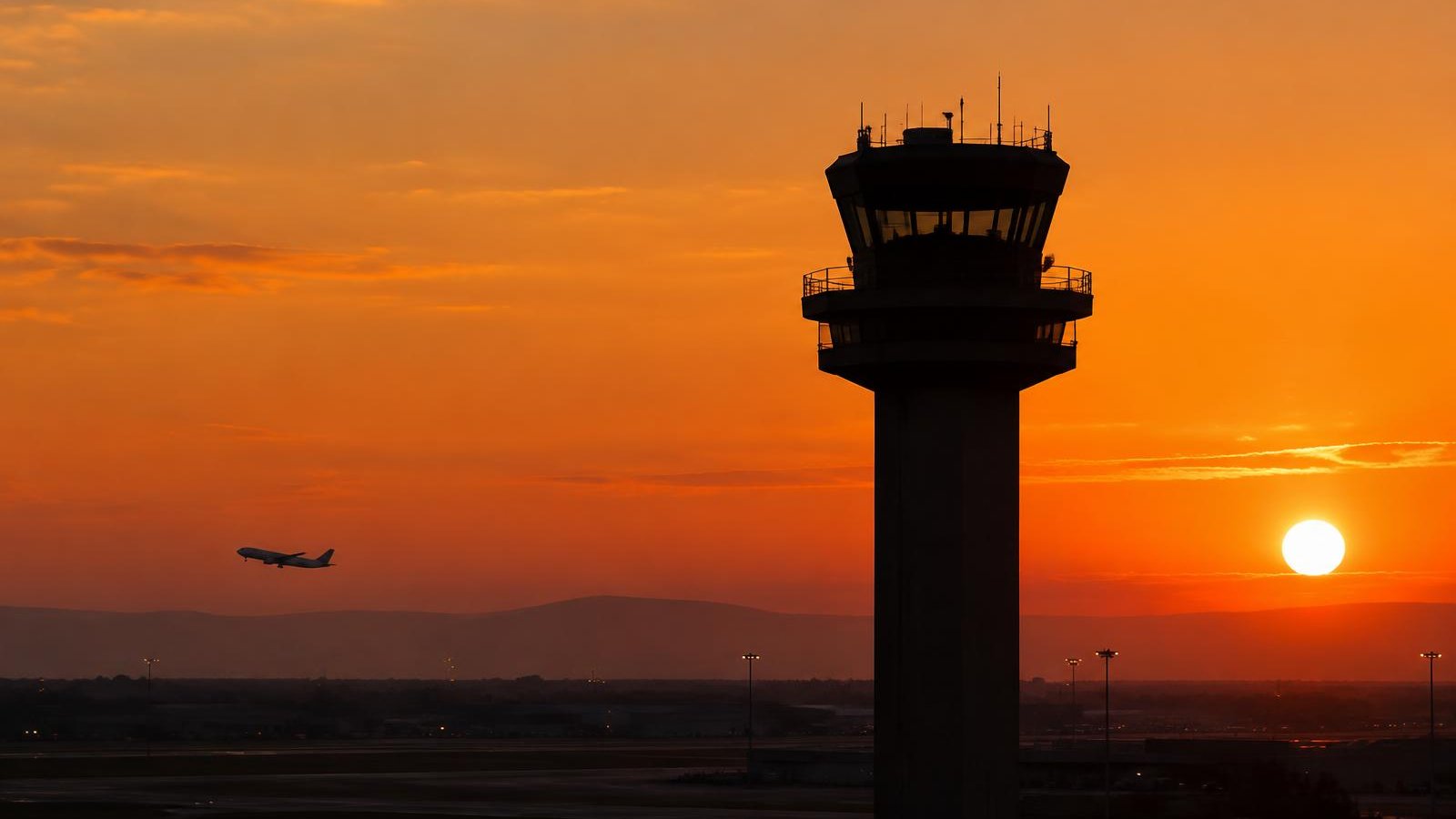
- the control tower, which manages movements on the runways and in the immediate vicinity of the aerodrome: take-off and landing clearances, ground movements;
- approach control, which handles the aircraft within the first few dozen kilometres around the airport, during the initial climb or the descent towards the runway;
- en-route control, provided from regional centres, which follows aircraft at cruising altitude.
At each transition the flight is "handed over" from one sector to the next: the pilot changes radio frequency and calls the next controller, who already has the flight plan information.
Five en-route centres and eleven regional services
En-route control is provided by five en-route air navigation centres (CRNA): Brest for the West, Athis-Mons for the North, Reims for the East, Aix-en-Provence for the South-East and Bordeaux for the South-West. Each centre's airspace is divided into sectors, which are opened or combined depending on the day's traffic.
Approach and aerodrome control are the responsibility of eleven air navigation services (SNA): nine in mainland France (from Lille to Nice, via the Paris region, Lyon, Toulouse and Bordeaux) and two overseas, in the Antilles-French Guiana area and the Indian Ocean. According to DSNA's 2024 annual report, the mainland network includes 28 approach units and 79 control towers. Separate services operate in Saint-Pierre-et-Miquelon, New Caledonia, Wallis and Futuna and French Polynesia.
The 2024 figures
DSNA's annual report gives a sense of the scale of the task:
- 3,391,151 flights controlled in 2024, up 6.5% on 2023;
- a peak of 11,632 flights on 5 July 2024, presented as a record;
- 7,002 staff at 31 December 2024, including 490 overseas;
- average air traffic control delay reduced to 1.57 minutes per flight, compared with 2.31 minutes the year before.
The same document acknowledges that France still accounted for around 16% of European air navigation delays and that the targets set by the European Commission had not yet been met. Modernising technical systems and recruiting controllers are among the levers it highlights.
A demanding job, coordinated at European level
DSNA's air traffic controllers are mostly air navigation control engineers (ICNA), trained at the French civil aviation university (ENAC) and then rated for a specific centre and type of sector. This local rating explains why a controller cannot simply move from one centre to another without further training.
French airspace does not operate in isolation. Flight plans and traffic flow management are coordinated at European level. When a sector's capacity is exceeded, for example because of thunderstorms or staff shortages, regulation measures require aircraft to wait on the ground for their departure slot. This is often the origin of the delays passengers are told about before they even board.
Key points
French air traffic control relies on a continuous chain, from the tower to the upper airspace, provided by DSNA. Its performance is measured in terms of safety as much as punctuality, and its annual results are published in an activity report that anyone can consult.
Sources
Related
Airports
Paris-CDG and Orly: two Paris airports with complementary roles
Nearly 107 million passengers passed through Paris-Charles de Gaulle and Paris-Orly in 2025. Two airports run by the same group, but with very different profiles and constraints.
23 October 2026
Airports
Airport security: what happens at the passenger screening checkpoint
Walk-through detectors, X-rays, body scanners, liquids limited to 100 ml: security screening is an unavoidable step before boarding. Here is how it works and which rules apply to cabin baggage.
22 October 2026
Airports
Numbers, markings, lights: how to "read" an airport runway
Why is a runway called 09/27 or 26R? What do the green, red and blue lights seen at night mean? A short guide to the conventions that help pilots find their way around an aerodrome.
4 October 2026