Airports
Numbers, markings, lights: how to "read" an airport runway
Why is a runway called 09/27 or 26R? What do the green, red and blue lights seen at night mean? A short guide to the conventions that help pilots find their way around an aerodrome.
By Rédaction··3 min read
A number taken from the compass
The two large digits painted at the end of a runway are not a serial number. They show the runway's orientation relative to magnetic north. Under an internationally harmonised principle, the magnetic azimuth of the runway centreline, measured clockwise, is divided by ten and rounded to the nearest whole number. A runway aligned at 268° therefore becomes runway 27.
The number depends on the direction of approach. The same strip of tarmac thus carries two numbers, one at each end, which always differ by 18: runway 09 seen from the west is runway 27 seen from the east. It is referred to as 09/27. In Europe, numbers below 10 are usually written with a leading zero.
Left, centre, right
When an airport has several parallel runways, they share the same number and are distinguished by a letter: L for left, R for right, and C for centre when there are three. The side is always judged from the point of view of a pilot on approach. Large airports with parallel runways, such as Paris-Charles de Gaulle, use this system.
When magnetic north moves
The magnetic North Pole moves slowly. Over time, the gap between a runway's actual orientation and its number can become large enough to require renumbering. This is what Gloucestershire Airport in the UK announced in May 2026: its main runway 09/27 becomes 08/26 and runway 04/22 becomes 03/21, to reflect changes in magnetic variation. Such a change means repainting markings, replacing signs and updating charts and navigation databases.
Ground markings
On a runway equipped for instrument approaches, several white markings guide the pilot:
- the threshold, made up of longitudinal stripes, which shows where the part of the runway available for landing begins;
- the centreline, a dashed line that helps with alignment during take-off and landing;
- the aiming point, two broad stripes on either side of the centreline, which serves as a visual reference for landing;
- touchdown zone markings, groups of bars that provide distance information.
Runway lighting
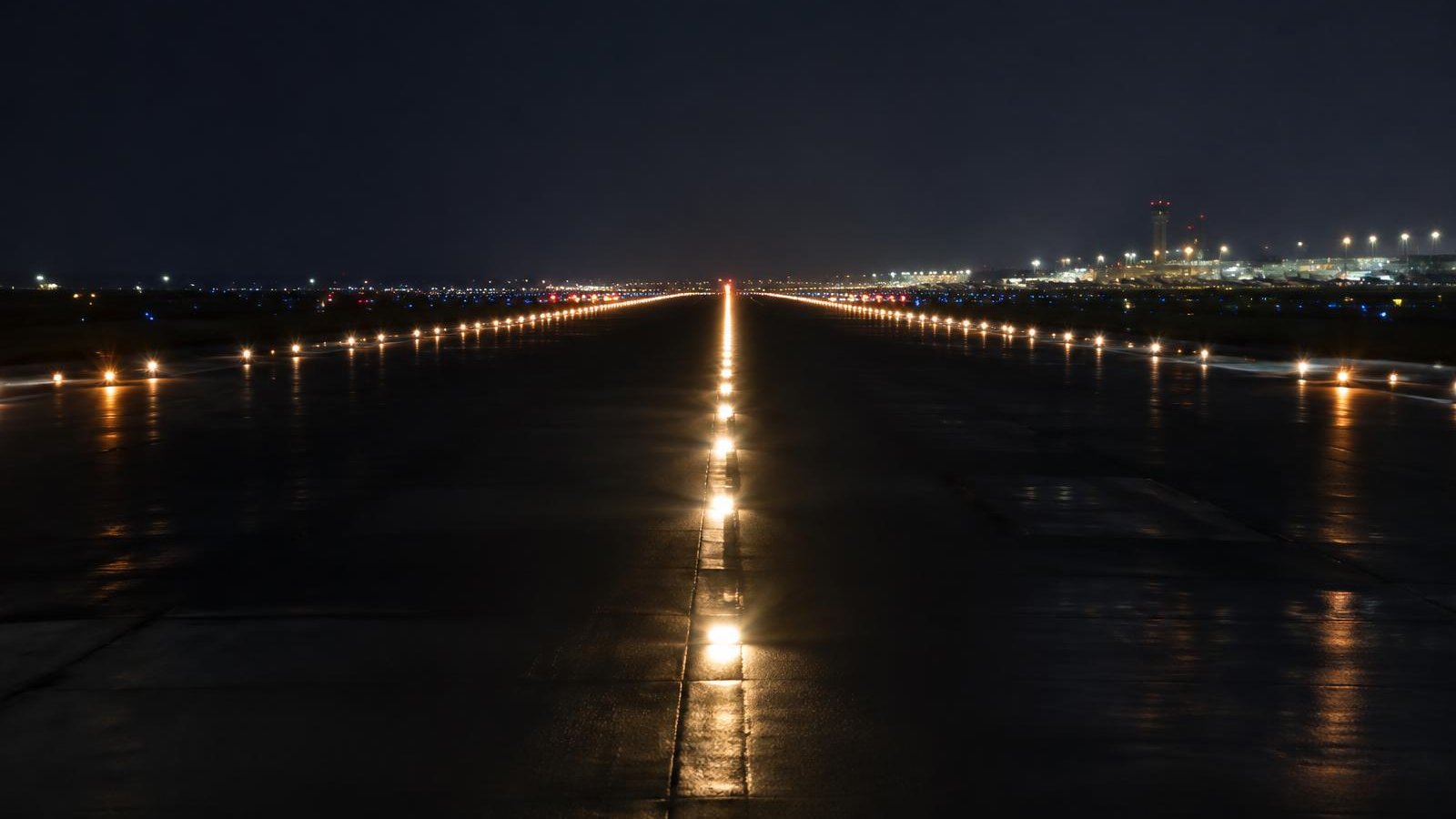
At night or in poor visibility, the runway is read through lights whose colours follow precise conventions:
- runway edge lights are white; on instrument runways they may turn yellow over the final part of the runway to warn that the end is approaching;
- threshold lights appear green to an arriving aircraft, while runway end lights are red when seen from the runway;
- centreline lights, on some runways, are white, then alternate white and red, before turning fully red as the end of the runway nears;
- taxiways are edged with blue lights, and their centreline may be marked with green lights.
Before the runway, an approach lighting system extends the centreline to help the pilot transition from instrument to visual flight. To one side, the precision approach path indicator (PAPI) shows a combination of white and red lights: an even mix means the aircraft is on the correct glide path, more white that it is too high, more red that it is too low.
A common language
These conventions, derived from International Civil Aviation Organization standards and applied by each national authority, allow a crew to find its way around an aerodrome it has never visited. Reference manuals such as the US Federal Aviation Administration's Aeronautical Information Manual describe them in detail and are freely available.
Sources
Related
Airports
Paris-CDG and Orly: two Paris airports with complementary roles
Nearly 107 million passengers passed through Paris-Charles de Gaulle and Paris-Orly in 2025. Two airports run by the same group, but with very different profiles and constraints.
23 October 2026
Airports
Airport security: what happens at the passenger screening checkpoint
Walk-through detectors, X-rays, body scanners, liquids limited to 100 ml: security screening is an unavoidable step before boarding. Here is how it works and which rules apply to cabin baggage.
22 October 2026
Airports
Air traffic control: how DSNA guides aircraft across French skies
Towers, approach units, en-route centres: behind every flight crossing France is a chain of controllers coordinated by DSNA. A look at an organisation that handled more than 3.3 million flights in 2024.
20 October 2026