Manufacturers
Airbus A220: from Bombardier's C Series to the Airbus range
Designed in Quebec by Bombardier, the aircraft joined the Airbus range in 2018 as the A220. It covers the 100-to-160-seat segment, between regional aircraft and the A320 family.
By Rédaction··3 min read
An aircraft born at Bombardier
The A220 was not designed by Airbus. According to the European manufacturer, the programme was launched by Bombardier in 2008 as the C Series, and the first flight took place in September 2013. The aircraft was developed for the market for jets of roughly 100 to 150 seats, a segment long served by shrunk versions of larger aircraft or by stretched regional aircraft.
In 2018, Airbus became the programme's majority partner. On 10 July 2018, at a ceremony at the Henri-Ziegler Delivery Centre near Toulouse, the CS100 and CS300 were renamed A220-100 and A220-300. The press release issued that day presented the aircraft as designed for around 100 to 150 passengers.
Two versions, one type rating
Airbus now offers two versions:
- A220-100: 100 to 120 seats in a typical layout, with an announced maximum range of 3,600 nautical miles;
- A220-300: 120 to 160 seats, with an announced maximum range of 3,450 nautical miles.
Both versions share a common pilot type rating. The manufacturer also offers a business version, the ACJ TwoTwenty, derived from the A220 airframe.
However, the A220 does not share the A320 family's type rating: its flight deck and systems stem from Bombardier's design. For an airline already flying A320s, introducing A220s therefore means a separate pilot group, specific training and a different spare parts inventory. This complexity cost has to be offset by operating gains on the routes where the aircraft fits best.
Recent technical choices
Like the A320neo, the A220 was designed around new-generation engines, in this case Pratt & Whitney geared turbofans. But unlike the A320neo, which re-engines a 1980s airframe, the A220 is an all-new aircraft. Airbus states that around 40% of its structure is made of advanced materials and claims a 25% reduction in fuel burn and CO₂ emissions per seat compared with previous-generation aircraft.
For passengers, the cabin stands out with a 2-3 economy layout, which limits the number of middle seats. For airlines, the appeal lies in offering high frequencies or opening thin routes with an aircraft smaller than an A320 but with comparable range.
Production on two continents
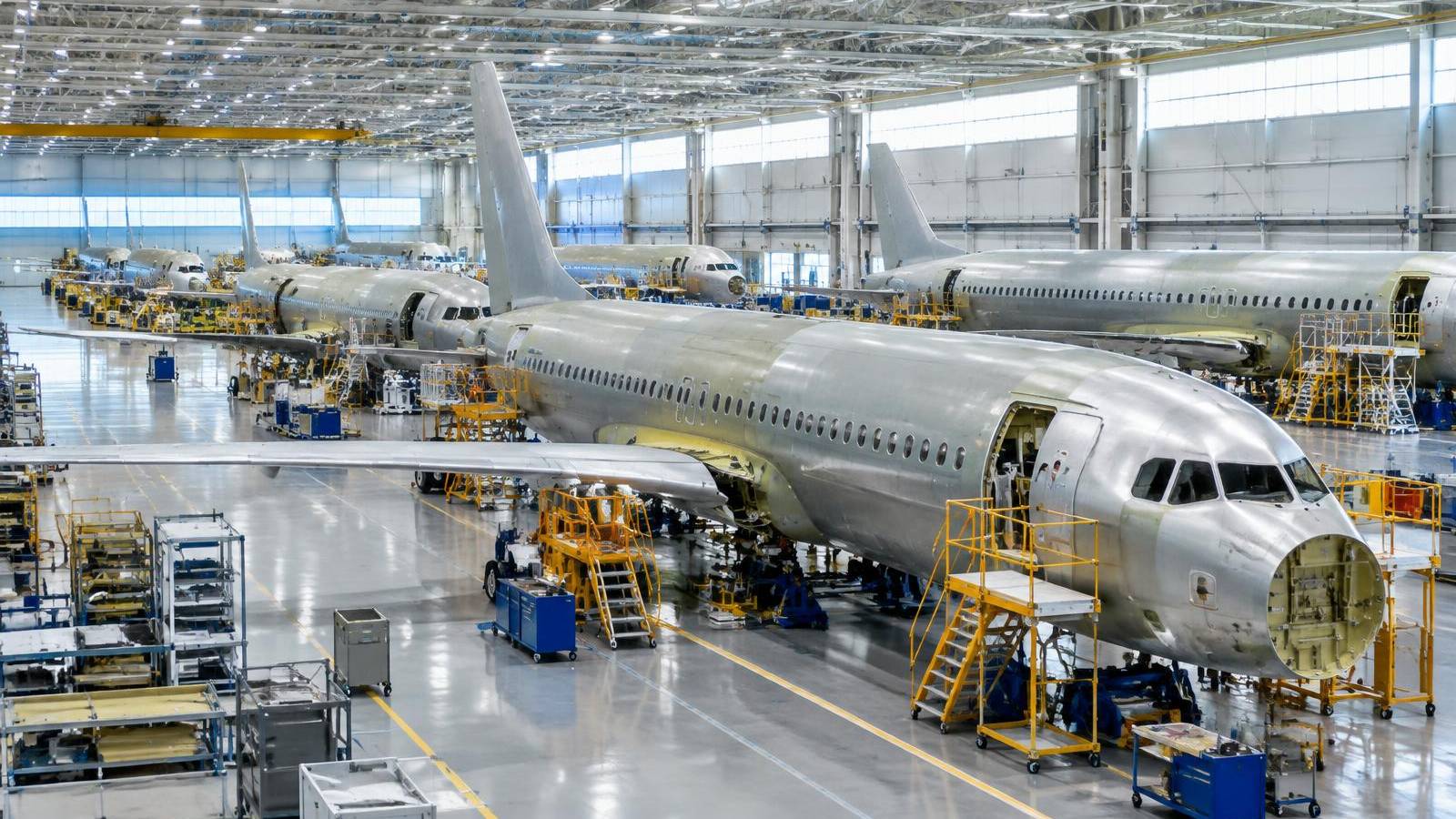
The A220 is built on three final assembly lines: two in Mirabel, Canada, the programme's historic home, and one in Mobile, Alabama, in the United States, according to Airbus. The US line reflects in particular the aim of being closer to a North American market that matters for this segment.
A programme still taking shape
According to figures displayed by Airbus, the A220 family has more than 1,100 orders, more than 500 deliveries and 25 operators worldwide. These volumes remain well below those of the A320 family, reflecting both the smaller size of the segment and the relative youth of the programme.
Airbus's industrial challenge is to reach a production rate and manufacturing cost that make the programme profitable over time. The manufacturer also faces direct competition from the Embraer E195-E2, positioned in a similar segment, and overlap with its own A319neo, which covers part of the same capacity range.
A place in airline strategy
In a fleet, the A220 often complements larger single-aisles: it serves routes where demand does not justify an A320 or A321, or allows more frequencies on business routes. Several European airlines have chosen it to replace their 100-to-150-seat aircraft, making it a familiar sight at the continent's airports.
Sources
Related
Manufacturers
ATR 42 and ATR 72: the regional turboprops designed in Toulouse
A joint venture between Airbus and Leonardo, ATR has established itself in the market for propeller-driven regional aircraft. Why the turboprop still makes sense on short routes, and how the ATR 42 and ATR 72 differ.
19 October 2026
Manufacturers
Airbus A350: the composite long-haul jet explained
In service since 2015, the A350 is Airbus's latest-generation widebody. Composite materials, a dedicated engine and two fuselage lengths: the technical choices that define the programme.
17 October 2026
Manufacturers
The A320neo family: how Airbus renewed its single-aisle best-seller
From the A319neo to the A321XLR, the A320neo family offers one airframe in several lengths and ranges. A look at the logic of a programme that has become the backbone of short and medium-haul flying.
16 October 2026