Innovation
eVTOL: how Europe certifies electric air taxis
Vertical take-off, distributed electric propulsion, urban flight: eVTOLs are neither aeroplanes nor helicopters. EASA has therefore built a dedicated certification and operating framework for them.
By Rédaction··3 min read
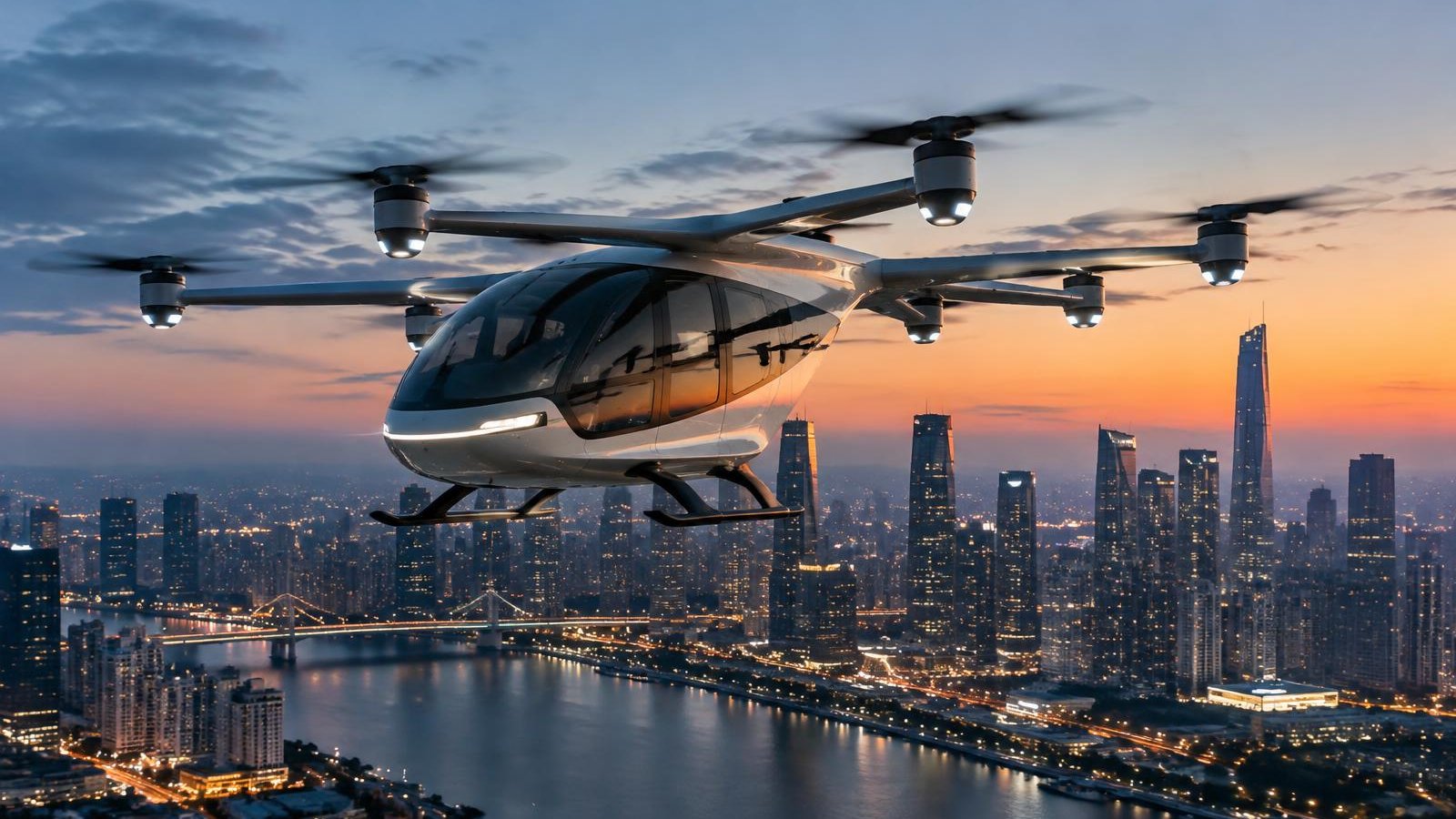
eVTOLs (electric vertical take-off and landing aircraft) are electric aircraft that can take off and land vertically like a helicopter, while some also fly like an aeroplane. They are central to what the European Union Aviation Safety Agency (EASA) calls Innovative Air Mobility: urban air taxis, short regional links, medical transport. Their arrival has forced authorities to adapt rules designed for very different machines.
Machines apart
A conventional helicopter relies on a large main rotor driven by a turbine. An eVTOL usually uses several electric motors driving rotors or propellers spread across the structure: this is distributed electric propulsion. Several architectures exist:
- multirotor, with many fixed rotors providing both lift and propulsion;
- lift + cruise, combining rotors for vertical flight with a propeller and wings for cruise;
- vectored thrust, where rotors or propellers tilt between vertical and horizontal positions.
Multiplying the motors provides redundancy: losing one motor does not necessarily mean losing the aircraft. But it also makes the aircraft's behaviour heavily dependent on fly-by-wire controls and the software running them.
SC-VTOL: a "special condition" since 2019
In the absence of a suitable airworthiness code, EASA published a special condition, SC-VTOL-01, on 2 July 2019. It applies to small-category, person-carrying vertical take-off aircraft with nine passengers or fewer and a maximum certified take-off mass of 3,175 kg, fitted with more than two lift or thrust units.
The text distinguishes two categories:
- Basic: after a failure, the aircraft must be able to make a controlled emergency landing, possibly with some damage;
- Enhanced: the aircraft must be able to continue safe flight and land at a vertiport.
The Enhanced category is mandatory for commercial air transport of passengers and for flights over congested areas. Safety objectives are then aligned with those of airliners: a catastrophic failure must be "extremely improbable", meaning a probability of no more than 10⁻⁹ per flight hour, and must not result from a single failure. Since then, EASA has regularly published means of compliance explaining how to demonstrate that these requirements are met.
Operating, flying, sharing the airspace
Certifying the aircraft is not enough. On 10 April 2024, EASA announced that the European Commission had adopted a package of rules giving the go-ahead for operations of VTOL-capable aircraft and air taxis. Based on an Agency opinion from August 2023, it covers in particular air operations (Air OPS), pilot licensing (FCL) and the rules of the air (SERA) for these piloted aircraft.
On 9 July 2025, EASA added acceptable means of compliance and guidance material, aiming to ensure these flights are safe within the air traffic management environment and to guide authorities, manufacturers and operators.
What remains to be proven
Several questions go beyond regulation:
- energy: batteries limit range and payload, and their ageing must be managed;
- infrastructure: vertiports are needed, with charging, procedures and urban integration;
- public acceptance, regarding noise, safety and the real value of the service, which EASA lists among its objectives;
- the business model, still to be proven at scale.
Key points
- eVTOLs rely on distributed electric propulsion and fly-by-wire controls.
- EASA certifies them under the SC-VTOL special condition published in 2019.
- Commercial passenger transport requires the "Enhanced" category, with safety objectives comparable to airliners.
- A European operating framework was adopted in 2024 and supplemented in 2025.
Sources
Related

Innovation
Sustainable aviation fuels: the timeline set by ReFuelEU Aviation
The EU's ReFuelEU Aviation regulation requires fuel suppliers to provide a growing minimum share of sustainable fuel at EU airports, from 2% in 2025 to 70% in 2050.
24 October 2026
Innovation
Hydrogen aircraft: what Airbus's switch to fuel cells changes
In 2025, Airbus revised its ZEROe roadmap and chose a fully electric aircraft concept powered by fuel cells. Why hydrogen is attractive, and why it remains so hard to carry on board.
7 October 2026
Innovation
Electric aircraft: why batteries still limit flight
The first certified fully electric aeroplane has been flying since 2020, but it carries two people for less than an hour. The explanation comes down to one figure: the energy stored per kilogram of battery.
23 September 2026