How it works
How does a turbofan engine work?
Suck, squeeze, bang, blow: an airliner's engine relies on a simple cycle applied to a very large mass of air. A step-by-step explanation of the turbofan, the engine fitted to almost every airliner.
By Rédaction··3 min read
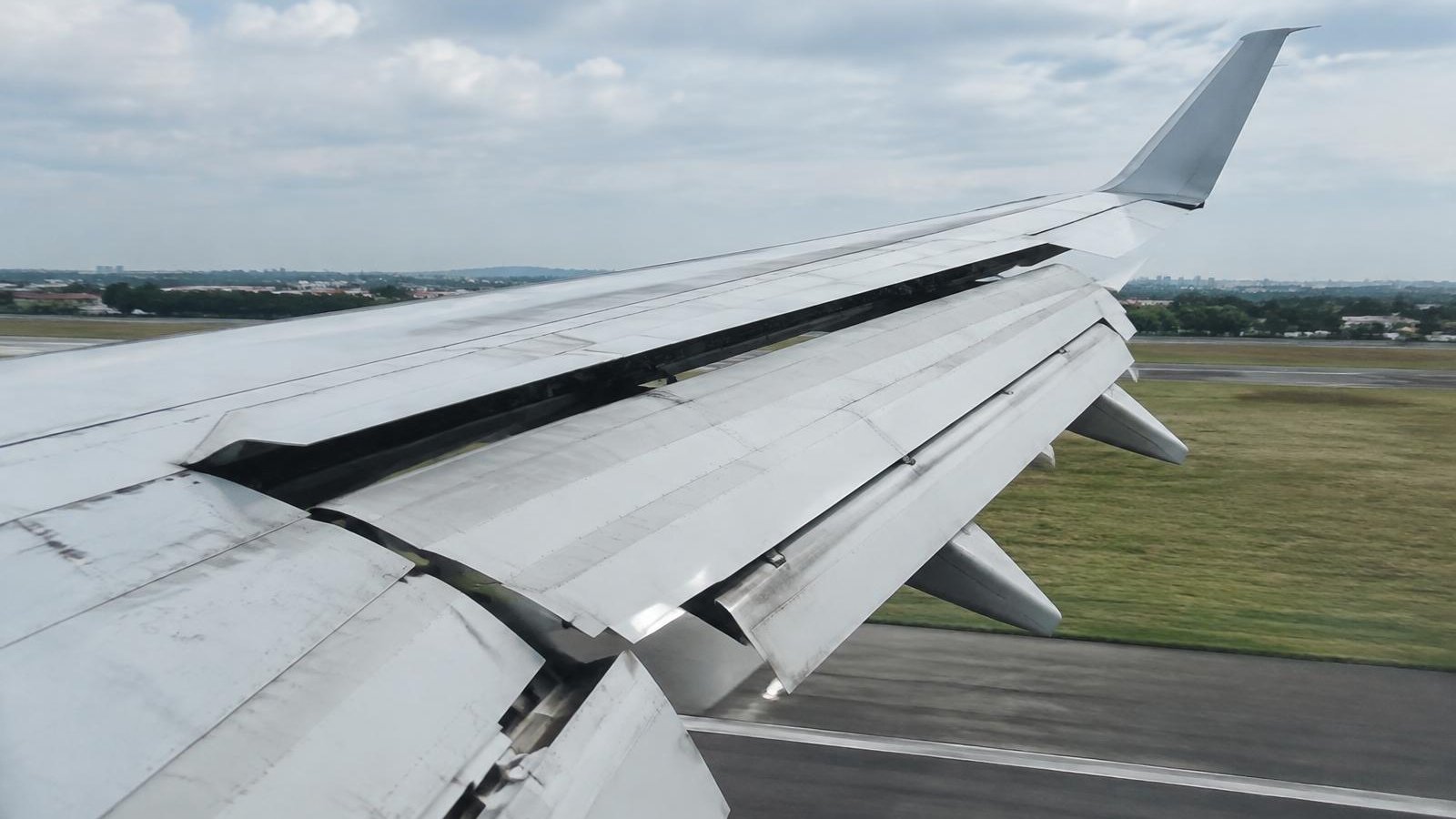
Under an airliner's wing, the large round "mouth" you can see is the fan of a turbofan engine. According to NASA's Glenn Research Center, it is the most modern type of gas turbine and the one used on most airliners, because it combines high thrust with efficient fuel burn. Its principle comes down to four steps, often summed up as "suck, squeeze, bang, blow".
The principle: reaction
An aircraft engine produces thrust by accelerating air backwards. In reaction, the aircraft is pushed forwards, rather like a balloon deflating. For a given thrust, you can either accelerate a small amount of air very hard, or accelerate a large amount of air a little less. The second option uses far less energy: that is the whole logic of the turbofan.
The engine core: a four-stage cycle
At the centre of the turbofan sits the gas generator, or core. It follows the Brayton thermodynamic cycle, which NASA describes in three main stages, preceded by intake:
- intake: air enters at the front of the engine;
- compression: a series of compressor stages, made of bladed discs, sharply raises the air's pressure and temperature;
- combustion: in the combustion chamber, fuel is injected and burns continuously at roughly constant pressure, and the gas temperature soars;
- expansion: the hot gases pass through the turbine, spinning it, then exit through the nozzle.
The turbine plays a key role: the energy it extracts drives the compressor at the front through a shaft. The engine therefore keeps itself running as long as it is supplied with fuel.
The fan and the bypass flow
What sets the turbofan apart from a simple turbojet is the large fan at the front. It is driven by an additional turbine at the rear, mounted on a shaft separate from the core's: this is the two-spool architecture, with a low-pressure spool (fan and low-pressure turbine) and a high-pressure spool (compressor and high-pressure turbine).
Air drawn in by the fan splits in two:
- the core flow, which passes through the engine core and takes part in combustion;
- the bypass flow, much larger, which goes around the core through an annular duct and exits at the rear, simply accelerated by the fan.
The ratio between these two flows is called the bypass ratio. On modern civil engines it is high: most of the thrust then comes from the bypass flow, much like a ducted propeller.
Why this engine is efficient
NASA sums up the benefit: adding a fan changes the core's fuel flow only slightly but significantly increases thrust. The engine therefore produces more thrust for nearly the same fuel. High-bypass turbofans thus approach the efficiency of turboprops, while remaining suited to the high speeds of airliners thanks to the ducted fan and its many blades.
The slower bypass flow, which surrounds the hot jet, also helps reduce noise compared with older single-flow turbojets.
An engine that powers the whole aircraft
A jet engine does more than provide propulsion. Through an accessory gearbox, it also drives electrical generators and hydraulic pumps. On most aircraft, compressed air is bled from the compressors to pressurise and air-condition the cabin or de-ice certain surfaces. Finally, on many aircraft the engine is fitted with thrust reversers, which redirect the flow forwards to help braking on landing.
Key points
- A turbofan accelerates a large mass of air backwards to produce thrust.
- Its core follows the Brayton cycle: compression, combustion at roughly constant pressure, expansion through the turbine.
- The turbines drive the compressor and the fan, mounted on two separate shafts.
- The bypass flow, which goes around the core, provides most of the thrust on modern engines and explains their efficiency.
Sources
Related
How it works
How an airplane flies: the four forces, simply explained
Lift, weight, thrust and drag: four forces are enough to describe how an aircraft flies. An explanation without unnecessary equations.
20 October 2026
How it works
Landing in fog: how ILS and Category III approaches work
When fog hides the runway, airliners can still land thanks to the ILS, a precision radio guidance system, and to automatic landing. Categories I, II and III explained.
11 October 2026
How it works
Black boxes: what flight recorders really record
After an accident, recovering them is a priority. What do "black boxes" contain, how do they withstand impact and fire, and how does France's BEA extract their data? An explainer.
6 October 2026