How it works
Pressurisation: how do we breathe at 35,000 feet?
At cruising altitude the outside air is too thin to breathe normally. Pressurisation recreates in the cabin an atmosphere comparable to that of a medium-sized mountain. Here is how.
By Rédaction··3 min read
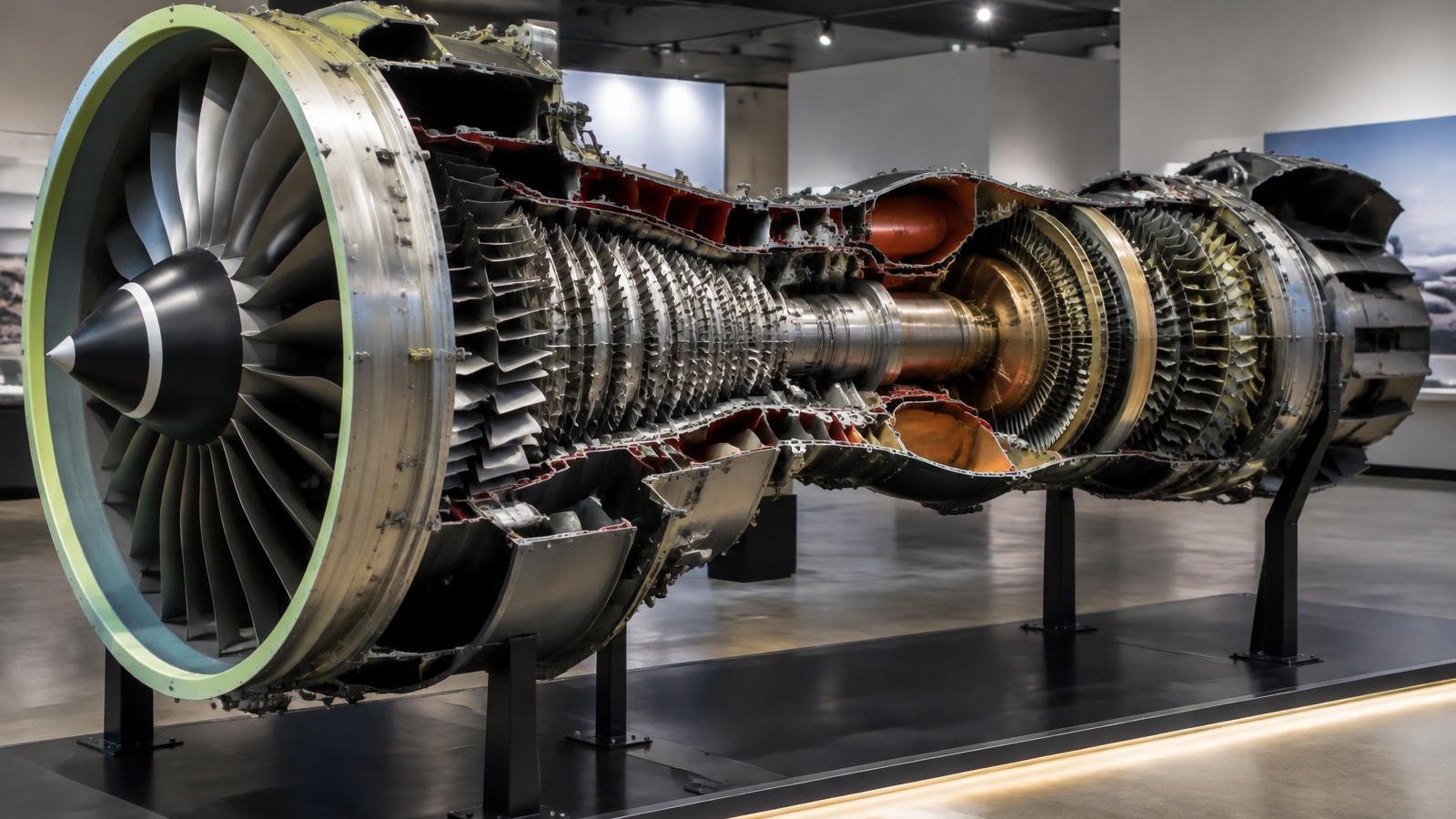
At 35,000 feet, roughly 10,700 metres, air pressure is only about a quarter of its sea-level value and the temperature is around -50 °C. Without protection, a passenger would lose consciousness within a few tens of seconds. If we can nonetheless travel in a T-shirt, it is thanks to pressurisation, one of the least visible yet most essential systems on an airliner.
The principle: inflating the cabin
An airliner's fuselage is designed as a sealed vessel. Air is constantly fed in, faster than it is let out. The inside pressure therefore rises above the outside pressure.
On most aircraft, this air comes from the engine compressors: it is called bleed air. As SKYbrary explains, it is filtered and cooled, then handled by the air conditioning system, which provides heating, cooling and pressurisation. Some recent aircraft use dedicated electric compressors instead, but the principle remains the same.
The outflow valve, conductor of the orchestra
The key component is the outflow valve, usually located at the rear of the fuselage. By opening more or less, it controls how much air leaves the cabin and hence the inside pressure. An automatic controller drives it according to the phase of flight: a gradual rise in "cabin altitude" after take-off, a steady level in cruise, then a gradual return to the pressure at the destination airport.
Two safety devices complete the system:
- a positive pressure relief valve, which opens if the inside pressure becomes excessive, for example if the outflow valve fails;
- a negative pressure relief valve, which opens if the outside pressure exceeds the inside pressure, notably during a rapid descent.
"Cabin altitude": a medium-sized mountain
The cabin is not kept at sea-level pressure: the pressure difference with the outside would require a much heavier structure. Instead, engineers speak of cabin altitude, meaning the altitude at which the pressure measured on board would normally be found.
The certification rules for transport aircraft, mirrored in equivalent terms in Europe, require cabin altitude not to exceed 8,000 feet (about 2,440 metres) under normal operating conditions. SKYbrary gives a typical example: 8,000 feet in the cabin when the aircraft is at 35,000 feet, and 5,000 feet when it is at 25,000 feet.
According to a report by the US National Academies, the 8,000-foot limit corresponds to a pressure of about 75 kPa, where the partial pressure of oxygen is about 74% of its sea-level value. That is sufficient for a healthy passenger, although some people may feel slightly tired or notice ear discomfort when the pressure changes.
Renewed, filtered air
Pressurisation goes hand in hand with air renewal. The same report states that part of the cabin air, typically 30 to 55% of the air supplied, is recirculated after filtering and mixed with outside air. On most recent aircraft the recirculation filters are HEPA filters, rated at 99.97% efficiency for 0.3-micron particles. The outside air, very dry at altitude, explains why cabin relative humidity is often between 10 and 20%.
And if the cabin depressurises?
Certification rules require the system to limit the consequences of a failure: for aircraft certified above 25,000 feet, a probable failure must not expose occupants to a cabin altitude above 15,000 feet. If pressure is lost, oxygen masks drop in front of every seat and the crew begins an emergency descent to an altitude where people can breathe unaided. The instruction is well known: fit your own mask before helping others.
Key points
- The aircraft is pressurised by feeding compressed air into a sealed fuselage.
- The outflow valve continuously regulates the inside pressure.
- Cabin altitude must not exceed 8,000 feet in normal operation.
- Part of the air is recirculated through HEPA filters, and oxygen masks provide protection if the cabin depressurises.
Sources
Related
How it works
How an airplane flies: the four forces, simply explained
Lift, weight, thrust and drag: four forces are enough to describe how an aircraft flies. An explanation without unnecessary equations.
20 October 2026
How it works
Landing in fog: how ILS and Category III approaches work
When fog hides the runway, airliners can still land thanks to the ILS, a precision radio guidance system, and to automatic landing. Categories I, II and III explained.
11 October 2026
How it works
Black boxes: what flight recorders really record
After an accident, recovering them is a priority. What do "black boxes" contain, how do they withstand impact and fire, and how does France's BEA extract their data? An explainer.
6 October 2026